
By Eyad, Founder of Afrah Events · Published · Last updated · 8 min read
Choosing a zaffe is less about selecting a national label than understanding the celebration your family recognizes. Eyad compares Lebanese, Palestinian, Egyptian, Syrian, and Jordanian references while explaining why repertoire, regional traditions, live instrumentation, and family participation deserve a detailed conversation before you decide how your entrance should unfold.
On this page
Why are national labels only a starting point?
A zaffe is a celebratory wedding entrance or procession, but the meaning and presentation vary between communities and families. National labels can help start a conversation, yet they cannot describe every regional custom, musical preference, or diaspora adaptation. Two couples requesting a Lebanese entrance, for example, may be imagining noticeably different sounds, formations, clothing, and levels of participation from relatives and invited guests.
Ask your families what makes an entrance feel familiar to them. Their answers might involve a particular rhythm, a song associated with family weddings, a style of drumming, or the way the couple is welcomed. Record those details and share references with prospective performers. Specific examples are more useful than expecting a broad cultural label to communicate an entire entrance concept without further discussion.
For a Florida ballroom, pair the cultural brief with a route drawing. Family videos can show the rhythm you want, but your venue may have a different doorway, ceiling height or gathering space. Preserving the feeling sometimes means adapting the movement rather than copying the original procession exactly.
What might couples mean by a Lebanese-style zaffe?
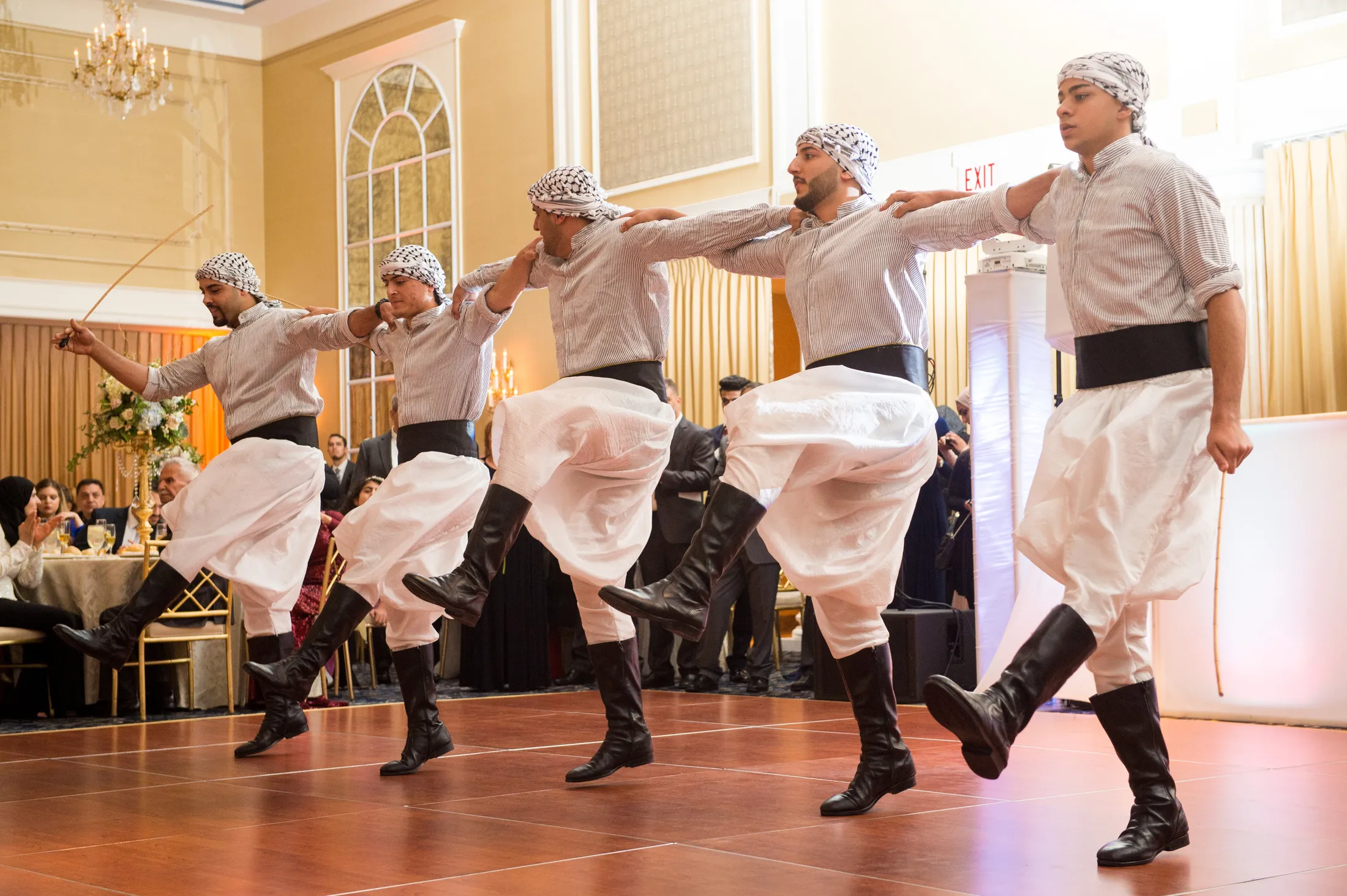
A Lebanese-style request often brings to mind a lively entrance with percussion, celebratory movement, and a strong connection between the performers and the couple. Some families also expect dabke-related energy or particular musical references. These associations are useful conversation starters, not a universal checklist. The actual proposal should identify the music, performers, instrumentation, and audience involvement rather than leaving everything inside the word Lebanese.
Consider whether you want a formal procession or a more interactive welcome. Ask how the performers would bring the couple into the room and how that entrance would connect with the reception music. If your family has a favorite recording or a familiar entrance tradition, share it directly. That gives the discussion a meaningful reference point without assuming every Lebanese household celebrates in the same way.
How do Palestinian and Jordanian references differ?
Palestinian wedding requests may place particular importance on dabke, collective participation, and songs with strong family or community associations. The desired presentation can depend on regional background and personal preference. Ask which elements your relatives consider essential and whether they expect a dedicated dance feature, an entrance procession, or both. Those choices affect the shape of the event more directly than a label alone.
Jordanian references may also emphasize communal celebration, line-dance traditions, and distinctive family expectations around welcoming the couple. There can be overlap with neighboring traditions, but overlap does not make every performance interchangeable. When comparing Palestinian and Jordanian concepts, discuss the actual repertoire, movement, dress references, and participatory moments. Let the family’s own preferences guide the distinctions instead of forcing the celebration into an oversimplified national category.
What should you explore for Egyptian and Syrian styles?
For an Egyptian-inspired entrance, discuss the sounds and celebration style you associate with family weddings, films, or particular regional traditions. Some couples imagine a strongly theatrical procession; others want a more intimate welcome centered on familiar music. Instrumentation and presentation vary, so ask the provider to explain the proposed arrangement. Avoid assuming that a single visual reference represents the full range of Egyptian wedding traditions.
A Syrian-style request also benefits from regional and family detail. You may be seeking particular songs, percussion, dance elements, or a specific procession atmosphere. Explain what feels authentic to your household and identify any aspects you would rather avoid. Comparing Egyptian and Syrian options is most productive when you compare concrete musical and performance choices, not claims that one entire culture is inherently more dramatic or traditional.
Can you combine traditions without losing coherence?
Mixed-family weddings often need an entrance that acknowledges more than one background. Start by identifying the elements that carry genuine meaning for each side. A particular song, a familiar rhythmic change, or a family participation moment may communicate more than a succession of national labels. Choose a clear overall structure so the entrance feels like one celebration rather than several unrelated demonstrations placed back to back.
Ask the performers how transitions would work and which combinations they can genuinely deliver. A group’s advertised repertoire should not be stretched into an assumption that every regional variation is available. Share pronunciation preferences for announcements and explain any sensitivities around songs or customs. When expectations differ, give the planner a clear, couple-approved direction so the entrance does not become a last-minute negotiation between relatives.
What should a zaffe proposal explain clearly?
Look for a description of the intended style, performer roles, music direction, and interaction with the couple and guests. Clarify whether the proposal concerns a procession, a stage presentation, dabke participation, or a combination. Ask how the entrance connects with the DJ and what the venue needs to accommodate. Those practical details help you evaluate whether the proposed performance matches your family’s actual expectations.
For Florida celebrations, share the venue location, entrance route, and any indoor or outdoor portions with Afrah. Cultural preferences should sit alongside access and production details in the planning conversation. Review the written booking process and confirmation requirements with Afrah. The best comparison is not a ranking of national traditions; it is a clear understanding of which confirmed performance approach will feel most meaningful to you and your guests.
Our favorite was definitely [the DJ and MC], [they] stuck to our playlists and meshed all our genres together effortlessly, guests raved about it.
Use regional labels to start a detailed conversation
Lebanese, Palestinian, Egyptian, Syrian and Jordanian labels can help introduce a zaffe discussion, but they do not describe one fixed performance for every family. Local traditions, religious background, generation and personal taste all influence the entrance. Diaspora celebrations may also combine several references. We recommend asking relatives for specific songs, chants or video examples and explaining which details matter. A clip may be useful because of its rhythm or family participation, not because you want every costume, prop and movement reproduced at your own wedding.
Build a brief that separates musical references, visual preferences and participation. Name the recording or chant, describe who joins the procession and identify any elements you do not want. If a relative uses a regional term unfamiliar to the planning team, ask them to explain the intended action. Our drummers need to understand what the family expects to hear and how the couple should move through the moment. A national label alone should never be used to promise instruments, attire or choreography that have not been discussed and confirmed.
Discuss Lebanese, Palestinian and Jordanian references specifically
For a Lebanese reference, ask which entrance songs, percussion patterns and presentation the family recognizes. Some couples associate their preferred entrance with particular drum arrangements or ceremonial visual elements, while others want a contemporary musical opening. Props such as swords are optional, not a requirement for cultural accuracy. Their use depends on the agreed performance, venue rules and professional assessment. Confirm whether the couple wants a procession, a stationary presentation or both. Those decisions affect the room plan more directly than a broad request for a traditional Lebanese entrance.
For Palestinian or Jordanian references, discuss the actual chants, songs and dance connections your family wants. Dabke may be important to the celebration, but it should not be assumed to be identical to the zaffe or identical across communities. Ask whether family members want to sing, lead a line or remain spectators during the entrance. If a particular guest will lead a participatory moment, identify that person before the wedding. Their role should connect with our performers and the DJ rather than beginning as an unexpected second sequence inside the same doorway.
Clarify Egyptian and Syrian expectations without stereotypes
For an Egyptian reference, start with the music and the processional format the family knows. Some couples may request the sound associated with mizmar or other specific instrumentation, but the exact lineup and availability need confirmation. Do not assume a recording in an inspiration video represents the live instruments included in a proposal. If candles or other visual elements appear in the reference, discuss them separately. Real flame is conditional on venue permission and any applicable requirements; a visual association is not a reason to bypass the approval process.
For a Syrian reference, ask about the family's city, community and personal song preferences only insofar as they help explain the requested performance. Avoid treating one example as representative of every Syrian celebration. A family may prioritize a familiar chant, a particular entrance recording or the way relatives gather around the couple. Ask someone knowledgeable in the family to review pronunciation where words are involved. We would rather receive a short, accurate reference than make an unsupported promise that a generic arrangement represents every part of a country's wedding traditions.
Combine backgrounds through an agreed musical sequence
When families have different backgrounds, give each meaningful reference an identifiable place rather than blending everything without explanation. One side's song might open the entrance while the other appears at the ballroom arrival or first guest dance. Decide the order with the couple and the relatives they choose to consult. Avoid measuring respect only by equal minutes. A short, recognizable passage may carry more meaning than a longer selection nobody requested. Our team should know which moments are essential and which can be shortened if the route takes less time than expected.
The proposal should identify the confirmed performers, instrumentation, attire, route, approximate performance window and any approved props. Ask what is live, what uses playback and who controls transitions. Review the plan with the venue before finalizing effects or equipment positions. Keep a clear destination for the couple and a defined handover to the DJ. At the final check, confirm song versions and family participation once more. Cultural care comes through accurate listening and agreed details, not through adding every possible regional symbol to a single entrance.
Continue planning with wedding entertainment packages, Miami venue logistics and Orlando resort planning.